

The Court’s illegitimacy has been building for a long time. Now, it is lost.
There are four ways that have combined to cause the Court to lose its legitimacy:
1. The Court’s broken, hyperpartisan, and random appointment process;
2. The length of time Justices can spend on the Court;
3. The corruption of individual Justices; and
4. The Court’s use of inconsistent logic to gradually claim excessive power over the other branches.
If there is a single moment after which the Court had become illegitimate, I believe it to be in October 2020, when Justice Ruth Bader Ginsburg was replaced by Justice Amy Coney Barrett. The confirmation of Justice Barrett was the end point of the years-long hyper-partisan strategy of the Republican Party. After President Obama nominated Judge Merrick Garland following the death of Justice Antonin Scalia in February 2016, Senate Republicans refused to hold any hearings on the nomination. At the time, they argued that, because it was an election year, the people should choose the President that would nominate the next Justice. If it was not obvious that this was a bad-faith argument in the moment, it became undeniable when Senate Republicans did the exact thing they argued against in 2020 in the nomination and confirmation of Justice Amy Coney Barrett. Except this time, it was even closer to the election.
With Justice Barrett’s confirmation, President Trump had appointed three of the nine Justices in a single term, one of which should have been appointed by President Obama. Another two Justices, Chief Justice Roberts and Justice Alito, had been appointed by President George W. Bush, who had first won office thanks to the Electoral College. Five of the six conservative Justices had been appointed by a President who had not won the popular vote. What mockery of popular legitimacy!
This series of hyperpartisan events from 2016 through 2020 demonstrate that the appointment process has become broken. This was the culmination of decades of increasingly bitter confirmation fights, as shown below.
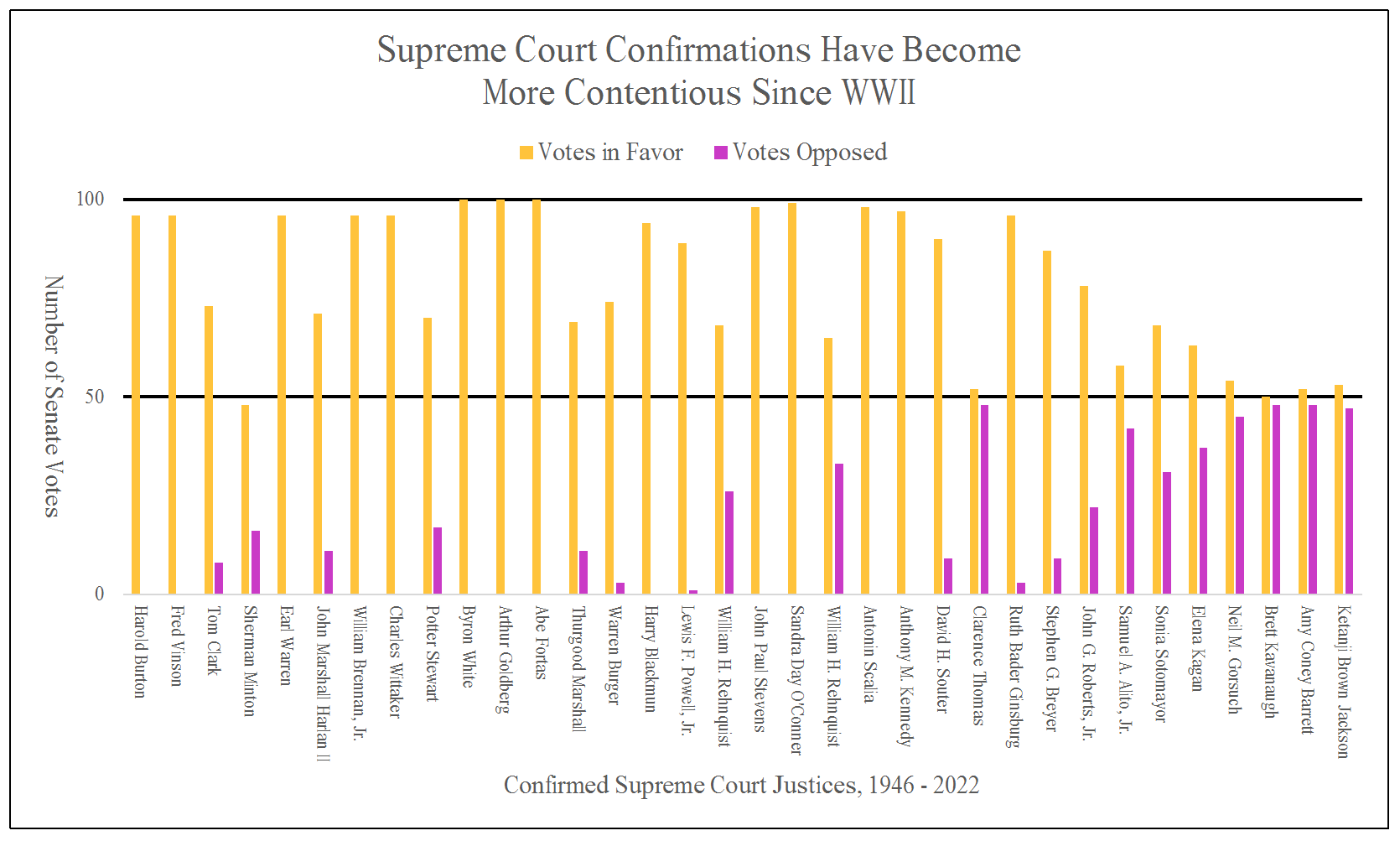
From 1946 to 1965 there were 12 Justices (Harold Burton to Abe Fortas) confirmed to the Supreme Court. Eight of those 12 Justices were confirmed by a voice vote, meaning that their nominations were so uncontroversial that the Senate confirmed them unanimously. Of the 14 Justices confirmed from 1967 to 1994 (Thurgood Marshall to Stephen Breyer), five were confirmed without a single vote opposed. The most disputed confirmations were those of William Rehnquist (26 votes opposed for Associate Justice in 1971, and 33 votes opposed for Chief Justice in 1986) and Clarence Thomas (48 votes opposed in 1991). Since 2000, every confirmed Justice (John Roberts to Kentanji Brown Jackson) has received at least 20 votes opposed. The last four confirmed Justices have had between 45 and 48 votes opposed. The current Supreme Court Justices had an average of 41 no votes at their confirmations. The confirmation process has never been as closely divided as it has been in recent years.
The lifetime tenure for Justices raises the stakes for each appointment. With longer lifespans thanks to modern medicine, a Justice confirmed at age 50 could plausibly be on the Court for 40 years! The nine justices currently on the Court were confirmed at an average age of 50 and can be expected to serve an average of 33 years if they remain on the bench until death, according to the Social Security Administration’s actuarial table.
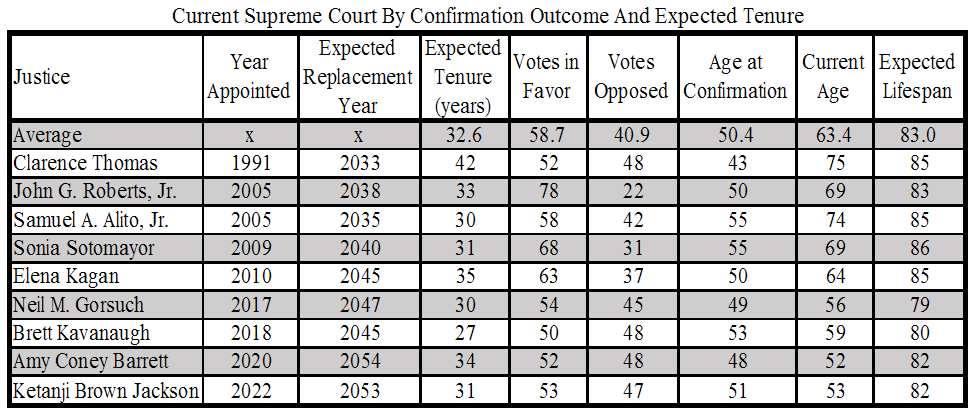
In recent years, Justices have chosen to retire when the presidency is occupied by someone they believe will appoint a similar-minded replacement. Justice Anthony Kennedy retired in 2018 to allow a Republican president to appoint his replacement, and Justice Stephen Breyer retired in 2022 to allow a Democratic president to appoint his replacement. In this way, only when there is an unexpected death of a Justice appointed by one party during the term of a President of the other party does the ideological makeup of the Court change, as it did with the death of liberal Justice Ruth Bader Ginsburg in 2020.
Thanks to longer lifespans, Supreme Court seats are filled less frequently than in the past. Since the end of WWII, there have been 1.7 Justices appointed per presidential term. This is lower than the 2.5 Justices appointed from 1869 through 1945, or the 2.0 Justices appointed per term from 1789 through 1869 when the Court had fewer than nine Justices.
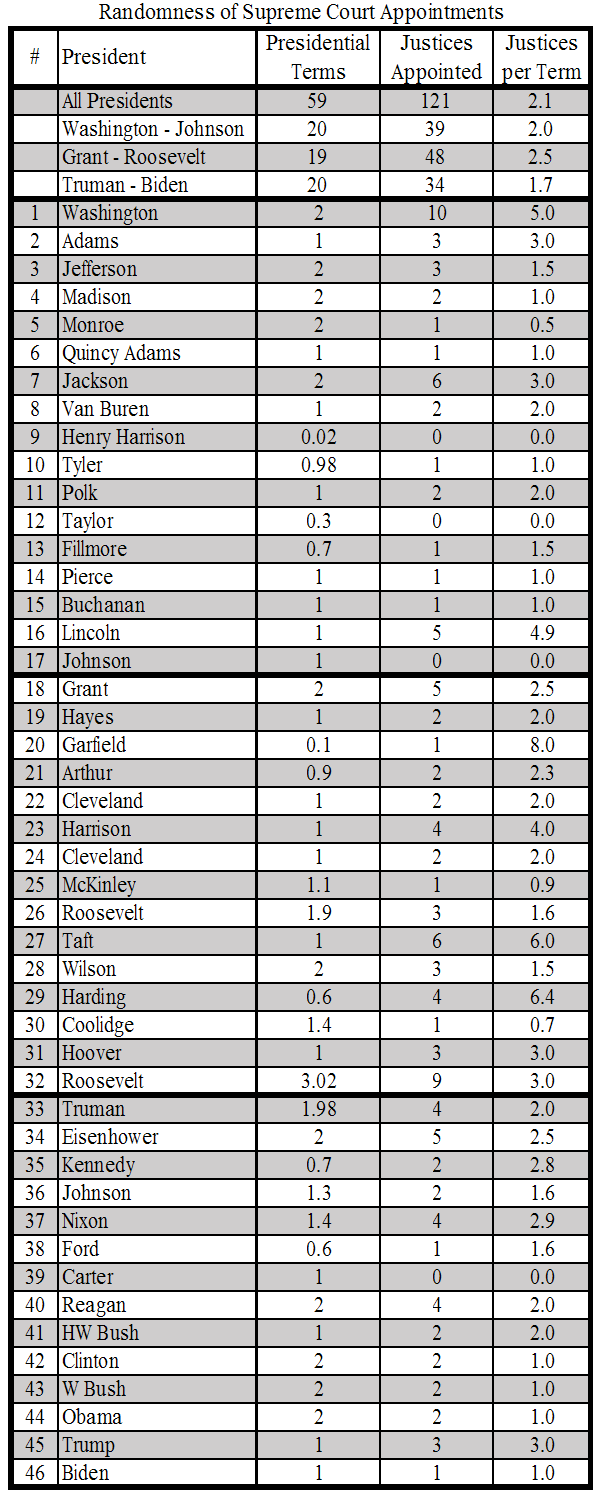
The randomness of how many appointments a President might make adds unnecessary stress to our system. The more infrequent the appointments, the more important they become, and the more our political parties are willing to risk to gain or deny an appointment.
Since the Carter Administration, there have been six Democratic presidential terms and six Republican presidential terms. Despite an equal time in control of the Executive branch, a combination of random luck of timely deaths, coordinated retirements, and one partisan theft resulted in Republican Presidents appointing 11 Justices compared to the Democrats five.
For people on the left like myself, what reason do we have to abide by the rulings of such a biased Court as it strips us of our rights, ruling by ruling, year by year?
There is a simple fix for the problems of randomness and lifetime tenure: a regular appointment schedule and a single, roughly 20 year term for Justices.
The issues of corruption and the Court’s power consolidation are not so easily fixed.
The conduct of these members of the court, in particular Justices Clarence Thomas and Samuel Alito, is blatantly corrupt and partisan. Justice Alito accepted luxury fishing trips - including flying on a private jet – from a billionaire who later had cases before the Supreme Court. Unsurprisingly, Alito ruled in favor of the billionaire in those cases. In addition to corruption, Justice Alito is blatantly partisan. While the Supreme Court was considering a case related to the 2020 election, an upside-down American flag, at the time a symbol of Trump’s Big Lie’s “Stop the Steal” movement, flew over Justice Alito’s front lawn. That is how the New York Times reported the news; note the passive voice in the previous sentence. Justice Alito’s responded to this revelation with an excuse that no objective observer would find plausible: “I had no involvement whatsoever in the flying of the flag. It was briefly placed by Mrs. Alito in response to a neighbor’s use of objectionable and personally insulting language on yard signs.” The timing of the events renders this excuse hollow. Justice Alito cannot be trusted to rule impartially. He should be removed from office.
Justice Thomas’s behavior is somehow even more egregious. For over 20 years, Justice Thomas accepted gifts from conservative billionaire Harlan Crow, and never disclosed them, in flagrant violation of ethics laws. These gifts included multiple luxury vacations, flights on Crow’s private jet and trips on Crow’s private yacht, paying for Justice Thomas’s grandnephew’s private school tuition, and purchasing and renovating Justice Thomas’s mother’s house. This corruption is laughably obvious! Further, Justice Thomas’s conservative activist wife Ginni Thomas spent the weeks following the 2020 election supporting efforts to prevent Joe Biden from assuming office. In a subsequent Supreme Court case which ensured Congress would be allowed to obtain records related to the January 6th insurrection, Justice Thomas was the lone dissent. Justice Thomas is corrupt and cannot be trusted to rule impartially. He should also be removed from office.
Justices Alito and Thomas are merely the most corrupt and partisan examples of a corrupt and partisan institution. In a deeply ironic speech at the McConnell Center for Justice, named for Republican Senate Majority Leader Mitch McConnell, Justice Barrett argued that the Supreme Court “is not comprised of a bunch of partisan hacks.” This, after the partisan hackery that allowed Justice Barrett to replace Justice Ruth Bader Ginsburg in the weeks leading up to the 2020 election. The Court has aided partisan Republican causes by acting either quickly (invalidating a Biden Administration vaccination policy) or slowly (taking so long to rule that a contested and Republican favored gerrymandered congressional map in South Carolina had to be used in an upcoming election).
Why should the rulings of an obviously corrupt and partisan Court be respected? Especially when that corrupt and partisan Court issues rulings devoid of consistent logic other than to give itself more power over the other branches of the government?
Such are the questions you might ask after reading Mark A. Lemley’s comprehensive November 2022 article in the Harvard Law Review titled “The Imperial Supreme Court.” Lemley dives into the opinions issued by the Court in recent years and shows that there is no consistent judicial philosophy behind their rulings, whether that philosophy be “originalism, textualism, dictionary fetishism, stare decisis, or anything else.” The only consistency is that the Court’s rulings “centralize power in the Supreme Court.” In other words, “the Court always wins” at the expense of administrative agencies, Congress, lower federal courts, States, and individual rights.
The Court’s June 2024 decision in Trump v United States proves Lemley’s argument. In this decision, the Court ruled that the President would effectively be above the law. Yet, even here the majority wrote “the decision so as to keep the power to decide which presidential acts would be “official” and immune to criminal prosecution, and which would be “unofficial” and therefore not. The president is immune, but only when the justices say he is. The president might seem like a king, but the justices can withhold the crown.”
Lemley concludes his article with what will be a familiar observation, that “the Court ultimately exists on the credibility of its judgments, and if it damages that credibility enough, the federal or state governments may decide that they can simply ignore it.”
Our current Court is illegitimate, and we could be one poorly received ruling away from the breakdown of law in our country. It could hasten Civil War, as it did in the 1850’s with its absurd Dred Scott decision.
If the 2024 Election is contested and decided in the Court, as was the 2000 Election, will the losing Presidential candidate accept the result as graciously as did Al Gore? And will the people whose candidate is on the losing side of such a Court decision accept it?